Quick Navigation
When you pick up a socket, ratchet, or torque wrench, you probably don’t think about the engineering standards behind it. But those standards are the reason a 1/2″ drive socket from any manufacturer fits the same ratchet, a torque wrench delivers accurate readings, and an impact socket survives thousands of high-force cycles without fracturing.
Four organizations define the rules that govern hand tool design and manufacturing worldwide: ASME, ANSI, ISO, and DIN. Understanding what each one does helps you make informed purchasing decisions and recognize the difference between tools that are built to spec and tools that merely look the part.
Why Standards Matter for Tools
Safety, reliability, and interchangeability start with specification
Tool standards exist to solve three fundamental problems. First, safety: a socket that shatters under impact or a torque wrench that reads 20% high can cause serious injury or equipment damage. Standards define minimum material hardness, wall thickness, and testing protocols that prevent catastrophic failure.
Second, interchangeability: the reason a 3/8″ drive ratchet accepts any 3/8″ drive socket is that both are manufactured to the same dimensional standard. Without it, every tool system would be proprietary, and you’d need a matching set from a single source for everything.
Third, reliability: standards set performance baselines. A torque wrench certified to ISO 6789 must deliver readings within a defined accuracy window. An impact socket meeting ASME specifications must survive impact testing at rated loads. These aren’t marketing claims — they’re measurable, auditable thresholds.
Why It Matters
Standards compliance isn’t just about meeting a spec on paper. It means the tool was designed, manufactured, and tested according to documented procedures — giving you a verifiable baseline of quality rather than a brand promise.
ASME: The Engineering Standard for Hand Tools
American Society of Mechanical Engineers — performance and dimensional specifications
Founded in 1880, ASME (American Society of Mechanical Engineers) develops technical standards used across engineering disciplines. For the hand tool industry, the critical series is ASME B107, which specifies dimensions, tolerances, material properties, and performance requirements for wrenches, sockets, ratchets, pliers, screwdrivers, and dozens of other tool types.
Key ASME B107 Standards for Tools
ASME B107.110 is particularly important for impact sockets. It specifies that impact-grade sockets must be made from chrome molybdenum steel, heat treated to a specific hardness range (typically 38-48 HRC), and tested under impact loading to verify they absorb energy without cracking. This is what separates a genuine impact socket from a chrome-vanadium hand socket that would be dangerous to use with a pneumatic or cordless impact driver.
ANSI: The Standards Coordinator
American National Standards Institute — accreditation and harmonization
ANSI (American National Standards Institute) is not a standards-writing body in the same way ASME is. Instead, ANSI serves as the coordinator and accreditor of the American standards system. When ASME develops a tool standard like B107.14, ANSI accredits the process and approves it as an American National Standard. That’s why you often see these standards cited as “ANSI/ASME B107.14” — the dual designation means the standard was developed by ASME and approved through the ANSI consensus process.
ANSI also represents the United States in international standards organizations, particularly ISO. This role is critical because it ensures American standards stay aligned with global requirements, so tools manufactured to ASME specs can meet international expectations and vice versa.
ANSI vs. ASME — The Simple Version
ASME writes the technical specifications. ANSI approves the process and ensures it followed consensus rules. When a tool meets “ANSI/ASME” requirements, it means the standard itself was properly developed and the tool meets its technical criteria.
ISO: The International Standard
International Organization for Standardization — global harmonization across 170+ countries
ISO (International Organization for Standardization) develops standards used worldwide. With member bodies from over 170 countries, ISO standards represent the closest thing to a universal engineering language. For hand tools, two ISO standards are especially relevant.
ISO 6789 — Torque Wrench Calibration
ISO 6789 is the global benchmark for torque wrench accuracy and calibration. It defines two classes: Type I (indicating torque tools, like click wrenches) and Type II (setting torque tools, like dial and digital wrenches). The standard specifies that a properly calibrated torque wrench must read within ±4% of the applied torque value across its rated range. It also mandates calibration procedures, environmental conditions for testing, and documentation requirements.
If you’re using a torque wrench for safety-critical fasteners — cylinder heads, wheel lugs, brake calipers — ISO 6789 certification is not optional. It’s the only way to verify that the reading on the tool matches the actual force being applied.
ISO 1174 — Socket Drives and Attachments
ISO 1174 defines the dimensions and tolerances for square drive connections — the interface between your ratchet and your sockets. It covers 1/4″, 3/8″, 1/2″, 3/4″, and 1″ drive sizes, specifying the exact dimensions of the square drive, the ball detent hole position, and the minimum torque capacity for each size. This is why sockets and ratchets from different manufacturers are interchangeable — they all conform to the same ISO drive geometry.
DIN: German Engineering Precision
Deutsches Institut für Normung — German national standards with global influence
DIN (Deutsches Institut für Normung) is Germany’s national standards body, and its influence on the tool industry is disproportionate to its national scope. German engineering standards are widely adopted across Europe and often serve as the foundation for ISO standards. Several DIN standards are essential knowledge for anyone working with hand tools.
Key DIN Standards for Tools
DIN 3120 defines the square drive geometry for socket wrenches. If you’ve ever wondered why a 1/2″ drive square has the exact dimensions it does, DIN 3120 is the answer. It predates and informed the ISO 1174 standard, and the two are now functionally harmonized.
DIN 3121 extends this to castle-style (knurled) drive connections, which are common on European ratchets and torque wrenches. The DIN 3121 profile provides more contact surface area and better torque transfer than a plain square drive.
DIN double flaring is a tube-forming standard widely used in automotive brake line work. While not a hand tool standard per se, DIN flaring tools and fittings are a common category in the professional tool market, particularly for European vehicle service.
DIN and ISO — The Relationship
Many DIN standards have been adopted into ISO with minimal changes. DIN 3120 became the basis for ISO 1174. When you see “DIN/ISO” on a tool, it means the product conforms to both the original German standard and its international equivalent.
Standards Comparison at a Glance
How ASME, ANSI, ISO, and DIN compare in scope, geography, and tool coverage
How Capri Tools Meets These Standards
Calibration certificates, material traceability, and engineering rigor
Standards only matter if they’re actually followed. Here’s how these standards are applied across the Capri Tools product line:
Torque Instruments — ISO 6789 Certified, NIST-Traceable
Every Capri Tools torque wrench and digital torque screwdriver ships with an individual calibration certificate. These instruments are calibrated to ISO 6789 requirements with traceability to NIST (National Institute of Standards and Technology). That means the calibration equipment itself is verified against national measurement standards — creating an unbroken chain of accuracy from the federal standard to the tool in your hand.
Impact Sockets — Chrome Molybdenum, ASME-Spec Hardness
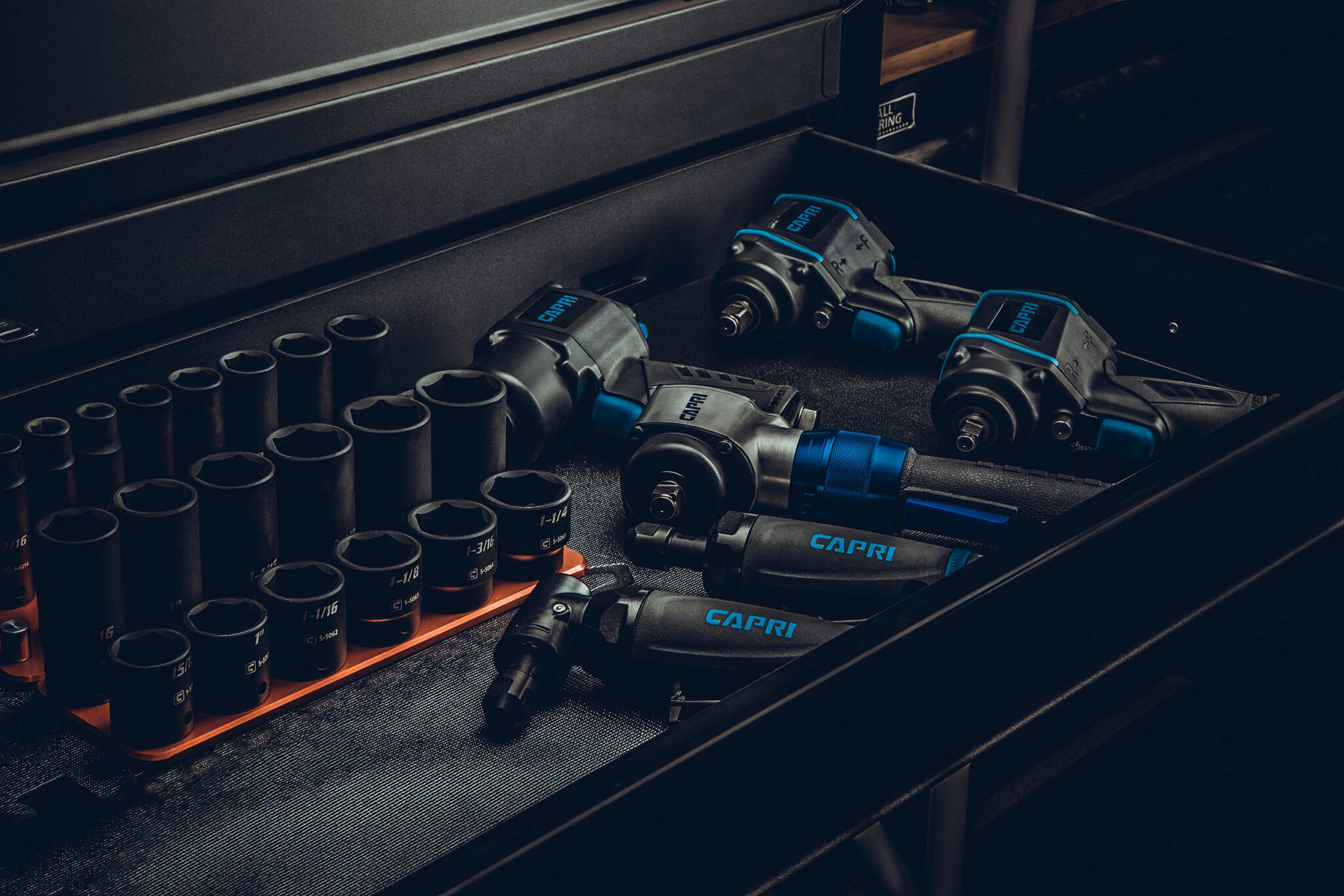
Capri Tools impact sockets are manufactured from chrome molybdenum (Cr-Mo) steel and heat treated to meet the hardness requirements specified in ASME B107.110. The phosphate finish provides corrosion resistance while clearly distinguishing impact sockets from chrome hand sockets — a visual safety feature that helps prevent the dangerous mistake of using a hand socket on an impact tool.
Hand Sockets and Ratchets — ISO/DIN Drive Geometry
All Capri Tools hand sockets and ratchets are manufactured to ISO 1174 and DIN 3120 drive specifications. This ensures full interchangeability with any standard-compliant tool system and guarantees the drive connection can handle its rated torque capacity without deformation.
What “NIST-Traceable” Means
NIST traceability means the calibration of each torque instrument can be traced through an unbroken chain of comparisons back to the National Institute of Standards and Technology. It’s the highest level of measurement assurance available in the United States and is required for aerospace, automotive, and medical device applications.
Frequently Asked Questions
Common questions about tool industry standards
What’s the difference between ASME and ANSI for hand tools?
ASME writes the actual technical standards (dimensions, materials, testing requirements) while ANSI accredits the development process and approves the final standard. When you see “ANSI/ASME B107,” ASME did the engineering work and ANSI verified it followed proper consensus procedures. For practical purposes, the technical requirements come from ASME.
Do I need ISO-certified torque wrenches for professional work?
For any application where torque accuracy matters — automotive service, aerospace assembly, industrial maintenance — yes. ISO 6789 certification with a calibration certificate is the only way to verify your torque wrench is accurate within ±4%. Many industries require it for liability and compliance reasons. Even for personal use, a calibrated torque wrench protects you from overtorquing critical fasteners.
Are DIN and ISO standards interchangeable?
In many cases, yes. Many DIN standards were adopted into ISO with minor modifications. DIN 3120 (square drive geometry) and ISO 1174 are functionally equivalent. However, some DIN-specific standards haven’t been adopted internationally. When a tool is marked “DIN/ISO,” it conforms to both.
Why are impact sockets held to different standards than hand sockets?
Impact sockets experience repeated high-energy blows from pneumatic or cordless impact tools — forces that would crack a chrome-vanadium hand socket. ASME B107.110 requires impact sockets to use tougher chrome molybdenum steel, achieve specific hardness ranges, and pass impact testing. The different material and treatment requirements are why impact and hand sockets are covered by separate standards.
What does NIST-traceable calibration mean?
NIST traceability means the calibration equipment used to test a torque wrench has itself been calibrated against reference standards that trace back to the National Institute of Standards and Technology. It creates an unbroken chain of measurement accuracy from the national standard to the specific tool’s calibration certificate. This is the highest level of assurance that a torque reading is accurate.
How often should a torque wrench be recalibrated?
ISO 6789 doesn’t mandate a specific recalibration interval — it depends on usage frequency and application criticality. General industry practice is to recalibrate annually for professional use, or every 5,000 cycles, whichever comes first. If a torque wrench is dropped or shows signs of damage, it should be recalibrated immediately regardless of schedule. Learn more in our guide to using a torque wrench.
Built to Standard
Tools Engineered to Meet the Standards That Matter
From NIST-traceable torque wrenches to ASME-spec impact sockets, every Capri Tools product is built to meet or exceed the industry standards professionals depend on.